Service Warrior, mapping the moments of misery.
Introduction
In this Service design case study I will show the step-by-step process used.
As a Junior Designer, Service Warrior was the first project I got assigned as a project lead. The role was to be a Service/User experience researcher and then report the resulted findings back to the client. My team consisted of 3 members each of us have diverse backgrounds and skills.
For Service warrior, my team and I were briefed to investigate and design the ideal hospitality journey. We used the method of design thinking to gain feedback and prototype different solutions with our waiters and their customers.
How the brief shifted
Initially the brief came in to recognise star employees in franchises for exceptional customer experience.
We wanted to simply run a radio campaign where customers could send in a voice note commending an employee after an exceptional experience.
However during the research phase we found frustration and limitations from having this initial idea come to life.
First there was an operational service design challenge to solve.
Customers and employees were experiencing multiple moments of misery and this led to frustration, a drop in brand perception and resentment rather than celebration toward colleagues recognised.
This project focused on key customers and small ways things like training, restaurant layout and menus could shift the outcome.
Client
Brandlove
Sector | Industry
Hospitality / Restaurant Industry
Timeline
Around a month
What I led and executed
What we did
THE QUESTION
“How might we improve a customer’s restaurant experience”
Business Aim
Was to find a way to:
Project challenge
As a team we wanted to find ways to up skill the people inside the hospitality industry within South Africa, while improving the restaurant experience for various user groups.
We were tasked to find touchpoints which typically caused moments of misery and then prototype solutions that could be trained to employees.
Our key objectives were:
THE PROJECT PROCESS
Empathize
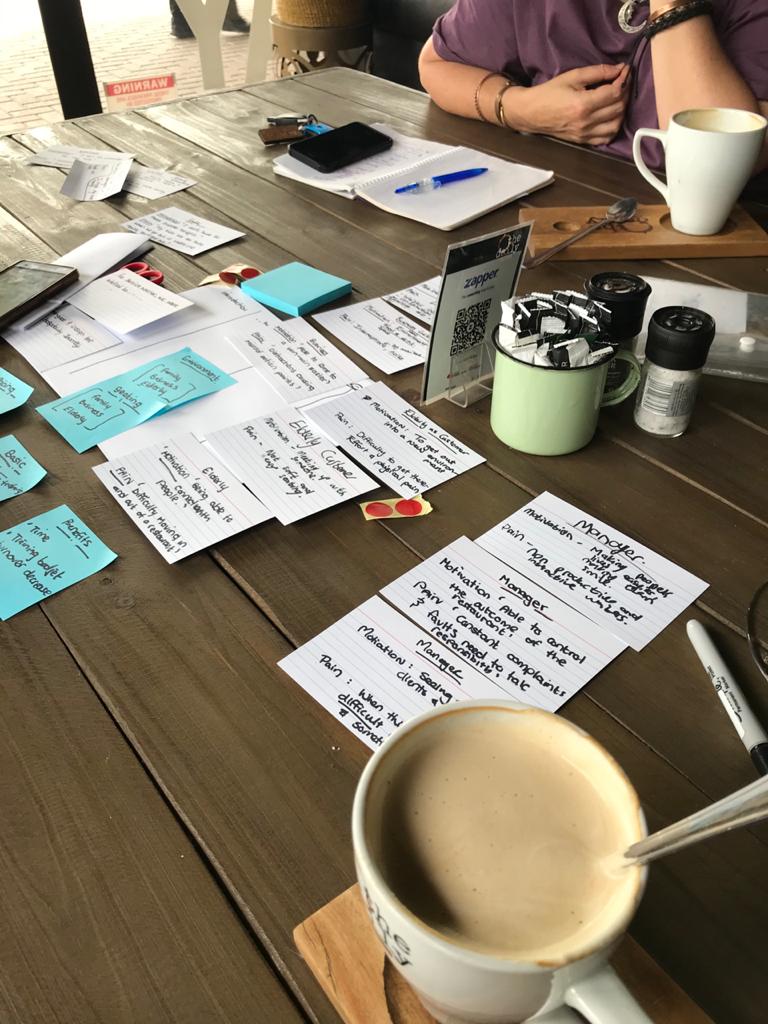
Interviews | Persona maps | Empathy mapping | Customer and Employee Journey mapping
Based on our interviews with our various user groups we found a few main points of opportunity namely;
User groups identified
{{ g.label }}
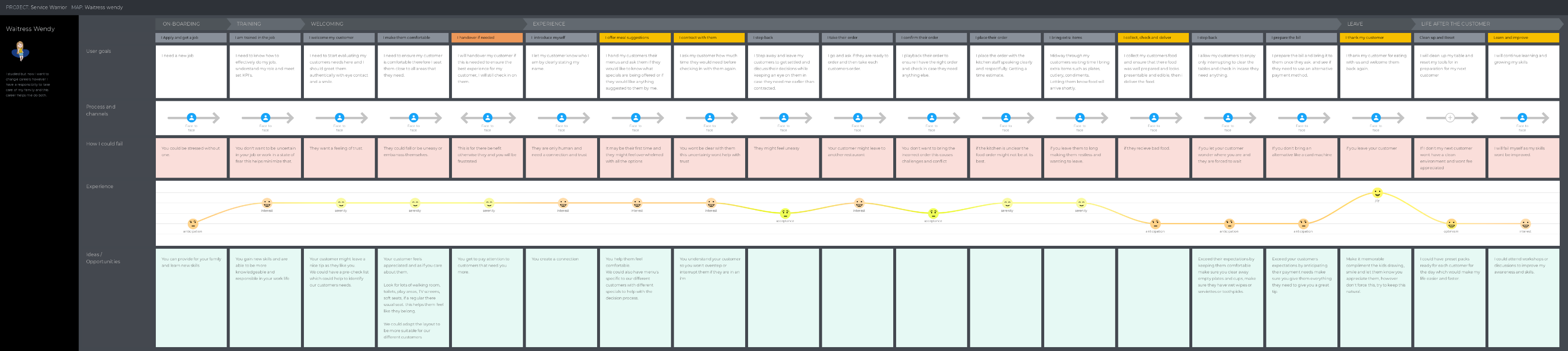
Customer Journey Map example: Waitress Wendy
Ideation
Brain dumping | The Worst Idea | Impact-Effort Map (Prioritization Exercises)
Due to limitations of time and cost, we focused our ideation towards the Training and Environment needs.
This decision was made after a prioritization process, Training would be able to focus on more touchpoints of an experience journey rather than just one or two smaller touchpoints and the focus on Environment proved to be an area which supported quick wins (places of innovation that can be implemented over a short period of time).
Our main ideation frameworks used were Divergent thinking (Braindumping and The Worst Idea) and Convergent Thinking (the Impact-Effort Map to help us prioritize our ideas and keep our focus.)
Design
Illustrator | Smaply | Milanote
After the prioritization exercise, I started designing the ideas into visual artefacts which we could take back to the user groups for testing
Prototyping & Testing
Low and High Prototyping | User Testing
Based on the feedback given to us after testing with a few of our user groups, we made a few iterations to our prototypes.
For the prototypes, we had solutions that solved the desirability aspect for our client’s customer and solutions that solved a more feasible aspect for our client and their business.
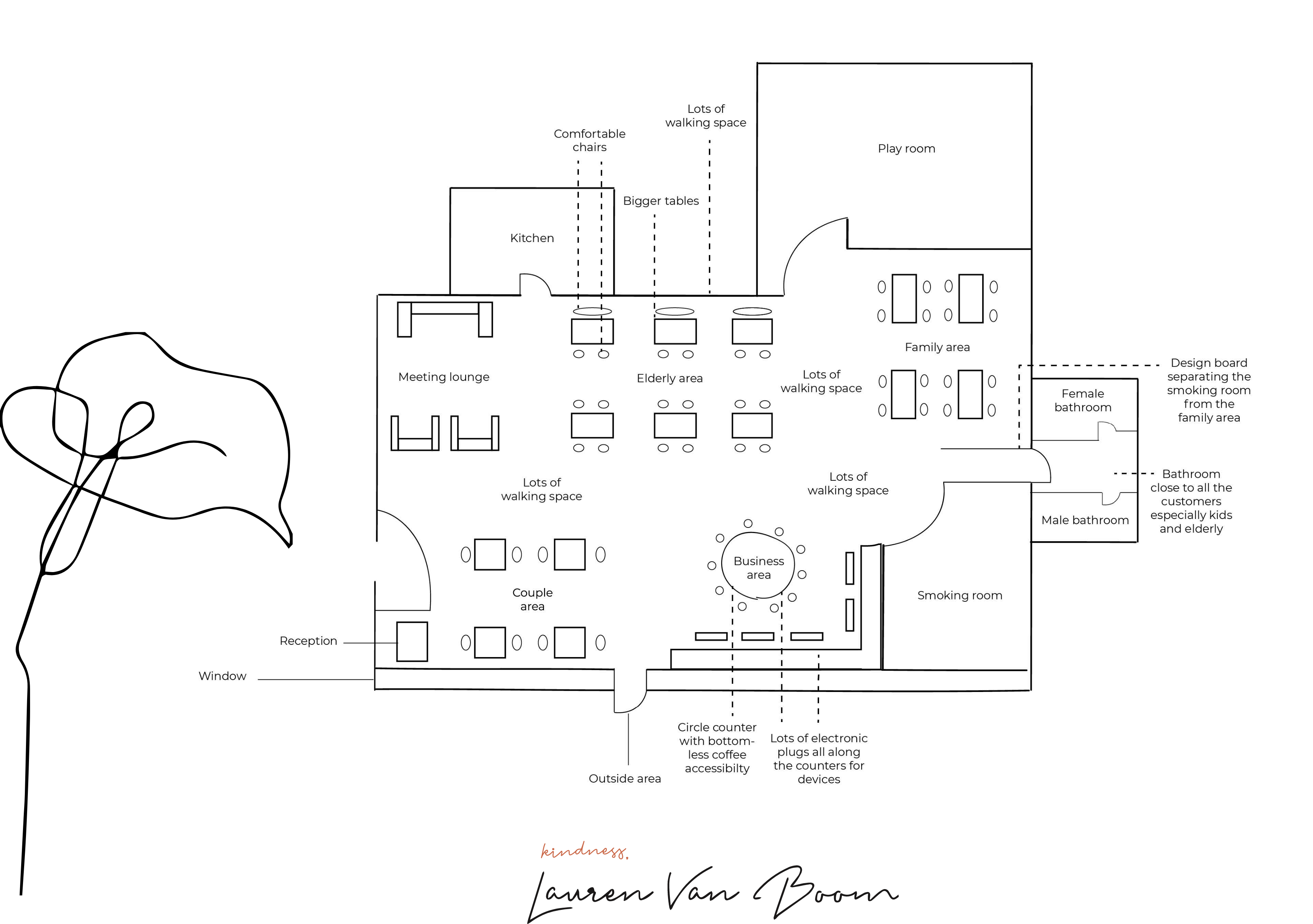
We discovered a few accessibility areas we could design for, Movement disabilities eg: Using wheelchairs, walkers, guide dogs; Language barriers or Social anxiety; Hearing disabilities; Blindness.
{{ p.label }}
Results and Benefits
With the completion of this project we are now able to move into a phase 2.
This phase allowed us to identify benefits and engage our main stakeholder.
This training programme will:
User Feedback
Feedback from users were positive, most users related to the layout of the restaurants and lack of empowerment in their roles to ensure the best products go out to the customers.
Our suggestion is that the manager gets equipped with the training knowledge and then trains their new employees. This allows the manager feel in control and be the person leading change in their industry.
The training journey should start at the on-boarding stage.
Reflection
This project took around a month which I believe is a fair timeline considering I led and executed along with my team in Project structure, planning, management, design research, design prototyping, recording and reporting and pitching back to executive.
Look at the numbers, look at training costs and what these new prototypes would cost a business. I would look at rate of improvement to the lives of the customers and the perception of the brand.
Because it was my first project led and I had to discover my structure, something I would be able to do now is communicate the project milestones earlier.
PROJECT DEEP DIVE
If you are looking for a project overview or if you would like a deeper dive into the prototypes designed and the learnings we received from them then download the pdf slides below.